

SometimesSheTookaPieceofPaperandToreItintoSmallPieces
Within this larger inquiry, the artist’s book makes visible the architecture of layered memory. It does not try to restore a whole image of my grandmother; it shows how memory works under illness — its fragmentation, non-linearity, and the capacity to keep some strata while others are lost beyond recovery.
The concept is built on the metaphor of the palimpsest: an image is taken apart into fragments, loses and regains wholeness, disappears entirely or dissolves — reflecting the loss of memory and of the ability to stay linked to the world.
Selected plates from the book — linocut portraits cut, shifted, and reassembled. The face is never fully restored; what remains is the work of holding the fragments together.
2025MoscowArtist’s bookLinocut / collage plates, variable formatsSeries of 8
The project grows out of watching my grandmother live with Alzheimer’s — the first time I encountered otherness tied to a mental condition, a confrontation with the Other. Conversation with her became a site of that otherness. Opaque, unreadable affects broke through the surface of her psyche, and a familiar person became unrecognisable.
“Sometimes she took a piece of paper and tore it into small pieces” was my grandmother’s attempt to fight for a personality that was gradually fading. When the illness closed in, conversation became hard; she grew nervous, unsettled, cloudy. She kept fidgeting with things — and sometimes simply took a sheet of paper, or a record sleeve, and tore it into tiny pieces. That gesture gave the project its name.
Each spread is a statement on its own, yet all are joined by one through-line: how we keep a bond with someone whose memory exists in a permanent state of disassembly. Attempts to remind of the past, to tether the Other to a shared reality, to survive the death of the “familiar” person and resist imposing one’s own perception — all of this is at once an unbearable and inevitable ethical relation.
The book sits beside the video work Silence in Two Rooms — another answer to the same ethical question: how to remain responsible for someone whose identity is falling into disconnected fragments.
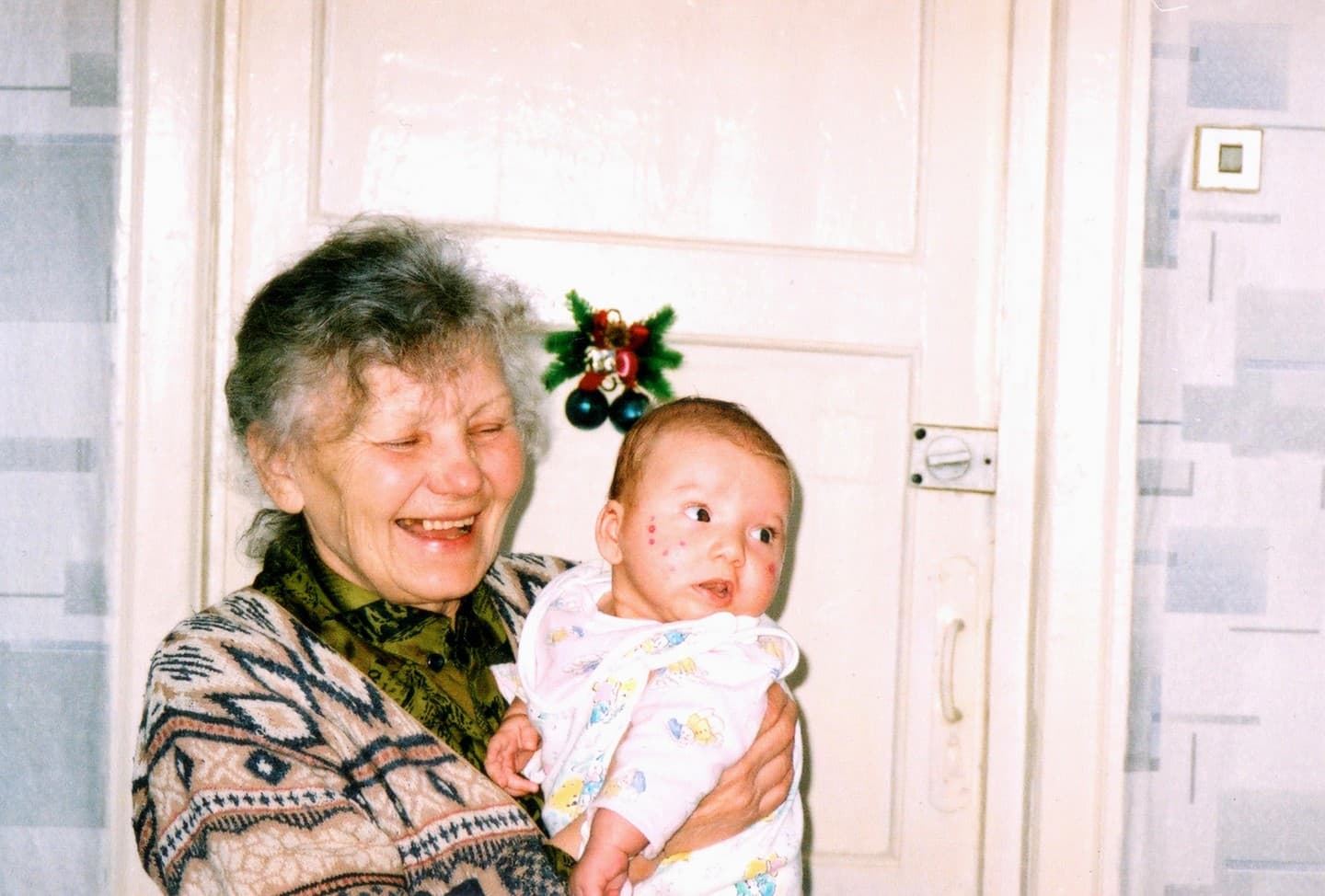
Family archive — grandmother with infant, undated.